GovMint·Government contracting·pillar·August 24, 2026·11 min read
Government Contractor Recruiting: A Guide to Award-Driven Hiring
How recruiting for government contractors differs from commercial hiring, what Award-to-Hire Intelligence means, and where the clearance and procurement facts below come from. Every procurement or clearance figure is cited to a federal source.
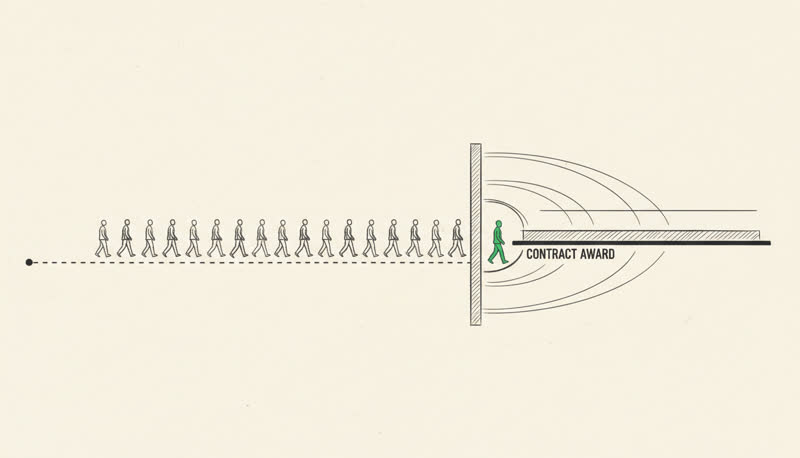
Government-contractor recruiting means hiring against cleared, technical and program roles on a timeline set by contract awards and clearance processing, not applicant flow. A role does not open because someone quit; it opens because an agency signed a contract, and the clock to staff a delivery team started the day of award, weeks or months before a job description exists.
$5.5 million: the contract-award value above which FAR Part 5 requires public announcement by 5:00pm Washington, DC time the day of award (Acquisition.gov, FAR Part 5)
44 days: DCSA's average Secret-level clearance-investigation processing time, fastest-90-percent standard, FY2026 Q2 (Trusted Workforce 2.0 QPR, FY2026 Q2)
57 days: the same standard applied to Top Secret-level cases, also FY2026 Q2, the fastest pace reported in over a decade
5 percent: the government-wide annual contracting goal for Service-Disabled Veteran-Owned Small Businesses (SDVOSB), per SBA's veteran contracting programs page
What government contractor recruiting actually means
Commercial recruiting starts with a headcount request. Government-contracting recruiting starts with a procurement event: an award, a task order, an option year exercised. The role, the location, the clearance level and the delivery date are usually fixed by the contract itself, not by a hiring manager's preference.
That changes what a search has to solve. The candidate pool is often narrower (cleared, cleared-adjacent, or willing to go OCONUS), the timeline is fixed by contract mobilization dates rather than internal urgency, and the roles span a wider range than most commercial searches: cleared talent, technical and professional services, logistics, training, linguists, skilled trades, OCONUS and international placements, program support, VP-level roles and operations, all of which sit under government contracting as one of the four sectors we search.
Location complexity compounds this. A program moving into delivery in a new country is not just a staffing problem; it is a search across whichever of the six regions we work (Western Europe, North America, Balkans, Eastern Europe, Middle East, Latin America) the delivery site sits in, because the strongest candidate for an OCONUS role is not always someone already in that country. The strongest candidate for an OCONUS role is not always someone already in that country; how we run an OCONUS recruiting search walks through the stages.
How award-driven hiring differs from commercial hiring
In a commercial search, the signal that a role exists is internal: a resignation, a budget approval, a board-approved headcount plan. In award-driven hiring, the signal is public and precedes the job requisition entirely.
That public signal is the contract award itself. Every contract action of $10,000 or more that a federal agency is required to report becomes visible through SAM.gov's contract-data records, according to SAM.gov's own description of what it covers. Awards above $5.5 million carry a further requirement: FAR Part 5 obligates the awarding agency to publicly announce the award by 5:00pm Washington, DC time on the day it is made, per Acquisition.gov's text of FAR Part 5.
Put together, those two mechanics mean a contractor's staffing need is often knowable in public records before the contractor has posted a single job. Waiting for the requisition to be written means starting the clearance clock, the relocation conversation, and the technical vetting weeks later than a search could have begun.
What award-to-hire intelligence tracks
Most recruitment starts when a role opens. We can start when the opportunity does, by monitoring newly awarded government contracts to identify contractors entering new programs, locations and delivery phases.
The clearance clock, and why it sets the real deadline
Contract award starts the workforce signal. Clearance processing sets the actual deadline a program manager is working against, and it is the part most commercial hiring processes have no equivalent for.
DCSA's Trusted Workforce 2.0 quarterly reporting for FY2026 Q2 put average investigation processing, using its fastest-90-percent standard, at 44 days for Secret-level cases and 57 days for Top Secret-level cases, the fastest pace reported in over a decade (Trusted Workforce 2.0 QPR, FY2026 Q2). Those figures describe the government's own processing pipeline, not how long it takes a contractor to find a candidate who already holds a clearance or is willing to sit through the process.
That distinction matters for how a search is built. A candidate with an active, transferable clearance closes a mobilization gap immediately. A candidate who needs to be sponsored into the process is, in practical terms, on a 44 to 57 day government clock before they can start regardless of how fast the recruiting side moves. The two populations are not interchangeable, and a requisition that can only be filled from one of them behaves differently on the calendar.
SDVOSB, set-asides and why the framework matters to staffing
A meaningful share of federal contracting dollars is set aside specifically for small businesses owned by veterans with service-connected disabilities. SBA's Service-Disabled Veteran-Owned Small Business (SDVOSB) program requires a firm be at least 51 percent owned and controlled by a service-disabled veteran, and the federal government's stated goal is to award at least 5 percent of contracting dollars to SDVOSBs annually, per SBA's veteran contracting assistance page.
For staffing, that framework shapes two things: the compliance obligations a prime or sub has to demonstrate around ownership and control, and the candidate pool for roles that benefit from direct familiarity with the government contracting ecosystem. Our team's background includes direct familiarity with the SDVOSB framework alongside U.S. military veteran experience and recruitment and workforce support across DoD, NATO, the U.S. Department of State, USAID, UN and international government contracting environments, which we describe in more detail on the team's background. That background also spans operating in the United States, Canada, EMEA, LATAM and South Africa, which matters for SDVOSB-eligible primes staffing international or OCONUS delivery sites alongside domestic program teams. The linguist and SDVOSB-adjacent side of this has its own stages, covered in how we run a linguist and SDVOSB search.
What it costs
Award-driven hiring does not carry a different fee structure from any other search. The same three models apply; the difference is which model fits the shape of the requirement.
Model
Fee structure
Fits when
Sourcing Sprint
Shortlist only, pricing on request
You know the role and clearance level, and can run interviews internally; we identify, engage and qualify candidates and hand over a calibrated shortlist
Full Search
Launch fee plus a success fee on placement
A cleared or hard-to-fill program role needs end-to-end management, from calibration through assessment, interviews, offer and close
Embedded Partner
Monthly fee plus a reduced success fee
A newly awarded program has several roles to staff at once, across cleared, technical and OCONUS positions, and needs ongoing recruiting capacity
Success fees vary based on role seniority, search complexity and hiring volume. Executive-level, highly specialized and unusually complex searches, which can include senior program-leadership roles, may be quoted individually. The Hiring Scorecard is a nine-question, 2 to 3 minute assessment that scores role clarity, hiring readiness, talent market fit and recruitment capacity, and its recommendation logic routes anyone with four or more open roles, or asking for ongoing support, toward Embedded Partner; sourcing-only for a single role toward Sourcing Sprint; everything else toward Full Search.
When award-driven recruiting fits, and when it does not
This approach earns its keep when the roles are cleared, technical, OCONUS, or tied to a program with a mobilization date that is not negotiable. It is a poor fit when the requirement is a single, clearly defined mid-level role with existing applicant flow and no clearance or location complexity: post it, run the interviews, and skip the overhead.
Signal
Points toward award-driven search support
Points toward posting it yourself
Clearance level required
Secret or Top Secret, or clearance sponsorship needed
No clearance requirement
Location
OCONUS, international, or a new delivery site
Existing office, local applicant pool
Number of roles tied to the award
Several roles across cleared, technical and program functions
One clearly scoped role
Timeline pressure
Program moves to delivery on a fixed contract date
No fixed external deadline
Internal recruiting capacity
Limited bandwidth for cleared-talent sourcing and vetting logistics
Existing recruiter with applicant flow already working
A readiness checklist before a program moves to delivery
Criterion
What "ready" looks like
Evidence to have on hand
Award confirmed
Contract action is public in SAM.gov, or announced under FAR Part 5 if above $5.5 million
Award notice or contract number
Clearance levels mapped
Roles are tagged Secret, Top Secret, or uncleared, with sponsorship plan for gaps
Program staffing plan by clearance tier
Location and OCONUS needs defined
Delivery site, relocation support and any status-of-forces considerations are documented
Program location and mobilization schedule
Compensation calibrated to the requirement
Range reflects the clearance level and location the role requires, not a single flat figure across the program
Documented compensation range tied to clearance tier and delivery location
Recruiting capacity assessed
Internal team has bandwidth to run cleared-talent sourcing on the program timeline, or does not
Current open-req count against internal recruiter capacity
The short version
Government-contractor recruiting is set by two clocks that commercial hiring does not have: a public procurement signal (SAM.gov's $10,000 reporting threshold, FAR Part 5's $5.5 million announcement rule) and a federal clearance-processing timeline (44 days for Secret, 57 for Top Secret, per DCSA's FY2026 Q2 reporting). Award-to-Hire Intelligence exists to act on the first clock before the requisition is even written. The fee models for running the resulting search, Sourcing Sprint, Full Search, or Embedded Partner, are the same three published on the Hiring Scorecard regardless of sector; what changes for government contracting is when the search starts and how the candidate pool is defined.
FAQ
What does Award-to-Hire Intelligence actually monitor?
It monitors newly awarded government contracts to identify contractors entering new programs, locations and delivery phases. The underlying data comes from public procurement reporting, principally the contract actions of $10,000 or more that SAM.gov requires federal agencies to report, and the public-announcement obligation FAR Part 5 places on awards over $5.5 million.
How long does it actually take to get someone cleared?
DCSA's FY2026 Q2 reporting put average investigation processing, on its fastest-90-percent standard, at 44 days for Secret-level cases and 57 days for Top Secret-level cases, the fastest pace reported in over a decade. That is the government's own vetting timeline; it does not include the time to identify and vet a candidate before sponsorship starts.
Is cleared-talent recruiting more expensive than a standard search?
The fee structure is the same three models published on the Hiring Scorecard: Sourcing Sprint, Full Search with a launch fee plus a success fee, and Embedded Partner with a monthly fee plus a reduced success fee. Fees vary with role seniority, search complexity and hiring volume, executive-level or unusually complex cleared searches may be quoted individually rather than on a standard fee, and pricing is available on request.
Does SDVOSB status change how a contractor should recruit?
It changes the compliance picture (ownership and control requirements tied to the 51 percent service-disabled veteran ownership standard) more than the recruiting mechanics, but the two intersect on roles like program management and business development where SDVOSB-framework familiarity and government-contracting experience genuinely narrow the usable candidate pool. Our team's direct familiarity with the SDVOSB framework, described on the team's background, comes from operating inside that framework, not from studying it externally.
When should a contractor just post the role instead of running a search?
If the requirement is a single, clearly scoped role with no clearance need, no OCONUS component and existing applicant flow, posting it and running the interviews internally is usually enough. Award-driven search earns its cost when clearance levels, location complexity, or the number of roles tied to a single award make internal sourcing capacity the actual bottleneck, which is the situation we describe in more detail in the government contracting category.
A government contract Program Manager hire is often bottlenecked by clearance timelines, not available talent. This guide covers what the role owns, what to evaluate, and how to time the search against contract award.
How Award-to-Hire Intelligence turns a contract award into an earlier-starting cleared-talent search, described as Recruitmint's general process pattern, not a specific past engagement.
The pattern a linguist or SDVOSB-contractor search follows at Recruitmint, including the SBA's own SDVOSB eligibility rules, described generally rather than as one client's story.
 Recruit