GovMint·Government contracting·walkthrough·August 24, 2026·8 min read
How We Run an OCONUS Recruiting Search
The pattern an OCONUS (Outside Continental United States) search follows at Recruitmint, including the federal support structure behind overseas contracting, described generally rather than as one client's story.
An OCONUS search follows the same shape as any Recruitmint search, calibration first, then sourcing, assessment, offer and close, but every stage carries an added layer: location, program requirements and clearance eligibility have to be locked before outreach starts. What follows describes that general pattern. It is not a narration of any specific past client engagement.
What OCONUS hiring actually requires before sourcing starts
OCONUS, Outside Continental United States, covers postings from Ramstein to Bahrain to Guam, and each one comes with its own mix of clearance level, physical requirements, dependent policy and program timeline. A candidate who is strong for a stateside version of the same role is not automatically eligible or willing to deploy overseas. That gap is why OCONUS / International sits as its own named role category under Government Contracting on the live site, alongside Cleared Talent, Technical & Professional Services, Logistics, Training, Linguists, Skilled Trades, Program Support, VP-Level Roles and Operations.
The practical effect: a search cannot start with a job description and a keyword pull. It has to start with a location and a program.
The federal support structure an OCONUS program sits inside
An OCONUS delivery phase does not operate in isolation. It sits inside a federal logistics and support infrastructure built specifically for overseas missions. GSA Global Supply maintains liaison officers embedded at the Defense Logistics Agency's operations center to support the Department of Defense's overseas missions, and it staffs dedicated regional points of contact spanning Hawaii, Alaska, SOUTHCOM, Europe, Africa, the Middle East, Japan, Okinawa, South Korea and Guam, 10 regional contacts in total, plus a National Customer Service Center (GSA, OCONUS Support). That structure describes the scale and shape of the environment an OCONUS program operates within. It is context a hiring leader should understand: the regions a program spans usually already have federal supply and liaison infrastructure built around them, which is a useful signal for what "OCONUS" actually spans operationally.
Where our own background actually applies here
Our team's published background includes recruitment and workforce support across DoD, NATO, the U.S. Department of State, USAID, UN and international government-contracting environments, along with large-scale workforce planning and mobilization and U.S. military veteran experience. That combination is directly relevant to an OCONUS search: understanding clearance timelines, program structures and mobilization logistics is part of what makes the sourcing conversation efficient rather than exploratory. For the fuller picture of how contract awards translate into hiring signals, see the government contractor recruiting guide and how Award-to-Hire Intelligence works.
The stage-by-stage pattern
Calibration
Calibration for an OCONUS search covers more ground than a domestic one. The conversation has to establish the specific location and program, the clearance level required, whether the posting is accompanied or unaccompanied, tour length, and how the role fits inside the delivery phase the contractor is entering. This is the same "understand what the business actually needs" discipline behind every search we run, applied to a role where the location itself is a hard constraint, not a preference.
Sourcing and qualification
Sourcing then runs against a narrower and more specific population: candidates who are both eligible (clearance status, prior deployment history, medical and dependent readiness) and willing to work in that location for that program. This is why the sourcing step is heavier than a standard search. A candidate who is a strong technical or operational fit but unwilling to relocate, or not currently holding the required clearance level, is not a viable candidate for this search, regardless of how strong the resume reads. Qualification calls confirm eligibility and willingness before a candidate ever reaches the shortlist.
Assessment through close
From there the process runs the same shape as a Full Search generally: candidate assessment against the calibration record, interviews, offer and close. What differs is what gets checked at each step. An interview scorecard for an OCONUS hire needs categories a domestic scorecard does not.
Criterion
What "strong" looks like
Evidence to ask for
Clearance status
Active clearance at or above program requirement, or clear adjudication timeline
Clearance level, granting agency, investigation date
Location willingness
Confirmed acceptance of the specific posting, not "open to OCONUS" generally
Direct confirmation of location, tour length, accompanied status
Prior OCONUS experience
Has completed at least one comparable overseas tour or deployment
Program name, location, duration (self-reported, not verified against a database)
Program and role fit
Skills map directly to the delivery-phase scope defined at calibration
Work history against the specific program requirements
Mobilization readiness
Passport, medical clearance and dependent logistics already in motion or understood
Candidate's own timeline for readiness relative to program start
Onboarding handoff
Close is not the end of the search's relevance. Mobilization for an overseas posting, medical clearances, travel, in-country onboarding, sits with the contractor's own program and logistics teams, informed by the federal support infrastructure described above. Our role ends at offer and close; what happens next is program mobilization, not recruitment.
Why this typically fits Full Search, not a Sourcing Sprint
A Sourcing Sprint works when a client can run interviews internally and just needs a calibrated shortlist. OCONUS searches rarely fit that shape, because the qualification work, confirming clearance, location willingness and mobilization readiness, is inseparable from the sourcing itself. Getting that wrong produces a shortlist full of candidates who look right on paper and are not actually deployable, which defeats the purpose of the shortlist. That is why this search type typically fits Full Search, run on a launch fee plus a success fee on placement, continuing through candidate assessment, interviews, offer and close, rather than the Sourcing Sprint. Fees vary based on role seniority, search complexity and hiring volume, and a highly specialized OCONUS or cleared search is quoted individually. Pricing is available on request.
A contractor running multiple concurrent OCONUS and cleared searches across a delivery phase, rather than a single role, is a different shape of problem, closer to what the Embedded Partner model (see the Hiring Scorecard) is built for. The Hiring Scorecard walks through role count, support needed and timeline in about two to three minutes and returns a model recommendation based on that.
How this connects to contract-award timing
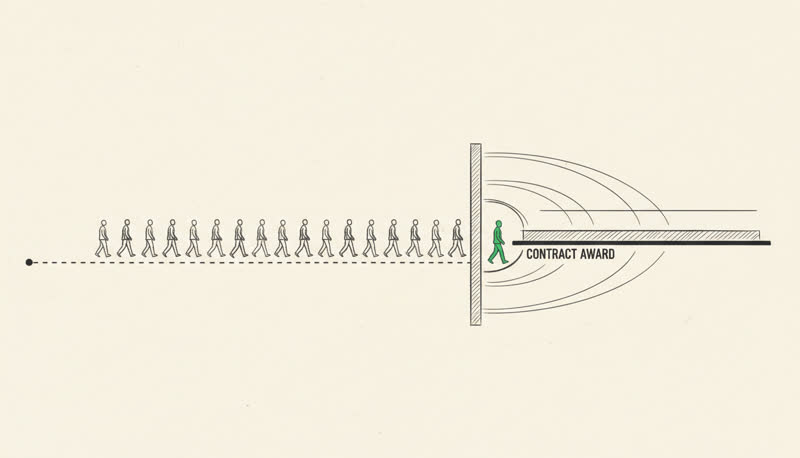
The earlier a contractor can see workforce demand coming, the more room there is to run this kind of calibration properly instead of compressing it under delivery-phase pressure. That is the premise behind Award-to-Hire Intelligence: we monitor newly awarded government contracts to identify contractors entering new programs, locations and delivery phases, moving from contract award to workforce signal to search activation before hiring becomes a bottleneck. The government contractor recruiting guide covers that pattern in full, and the Award-to-Hire Intelligence page walks the three steps as published.
The short version
An OCONUS search runs the same calibration-to-close shape as any search we run, but calibration has to lock location, program and clearance requirements up front, and sourcing has to qualify candidates on eligibility and willingness before skill match even matters. That specialization is why this search type typically fits Full Search rather than a Sourcing Sprint. Federal infrastructure, like GSA Global Supply's 10 regional OCONUS contacts, describes the environment the program sits inside, not a service we provide. The Hiring Scorecard is the fastest way to confirm which model actually fits a given role count and support need.
FAQ
What makes OCONUS recruiting different from domestic government contractor hiring?
The core difference is eligibility, not just skill. A candidate has to be both willing to work in a specific overseas location under specific conditions (accompanied or unaccompanied, tour length, program timeline) and cleared or clearance-eligible at the level the program requires. Calibration has to lock those details before sourcing starts, which is why OCONUS searches carry more upfront specificity than a comparable domestic role.
Does Recruitmint have offices or staff in the regions where OCONUS postings occur?
That is not something we publish or claim. What we do publish is team background: recruitment and workforce support across DoD, NATO, the U.S. Department of State, USAID, UN and international government-contracting environments, plus large-scale workforce planning and mobilization experience, which informs how we run sourcing and qualification for these searches.
What fee model applies to an OCONUS or cleared search?
Given how specialized the sourcing is, this typically fits Full Search, run on a launch fee plus a success fee on placement, covering calibration through candidate assessment, interviews, offer and close. Fees vary with role seniority, search complexity and hiring volume, and executive-level, highly specialized and unusually complex searches are quoted individually. Pricing is available on request.
How does GSA's OCONUS support structure relate to a Recruitmint search?
It does not describe anything we do. It describes the scale of the federal support infrastructure an OCONUS program operates within, including GSA Global Supply's liaison officers and its 10 regional contacts spanning Hawaii, Alaska, SOUTHCOM, Europe, Africa, the Middle East, Japan, Okinawa, South Korea and Guam. Understanding that structure helps a hiring leader see what "OCONUS" actually spans operationally, separate from the recruiting itself.
Can a contractor start this process before a role is formally open?
Yes, that is the premise of Award-to-Hire Intelligence: we monitor newly awarded contracts to identify contractors entering new programs and locations, so search can begin closer to the point of workforce signal rather than waiting for a job requisition to post.
How recruiting for government contractors differs from commercial hiring, what Award-to-Hire Intelligence means, and where the clearance and procurement facts below come from. Every procurement or clearance figure is cited to a federal source.
A government contract Program Manager hire is often bottlenecked by clearance timelines, not available talent. This guide covers what the role owns, what to evaluate, and how to time the search against contract award.
How Award-to-Hire Intelligence turns a contract award into an earlier-starting cleared-talent search, described as Recruitmint's general process pattern, not a specific past engagement.
 Recruit