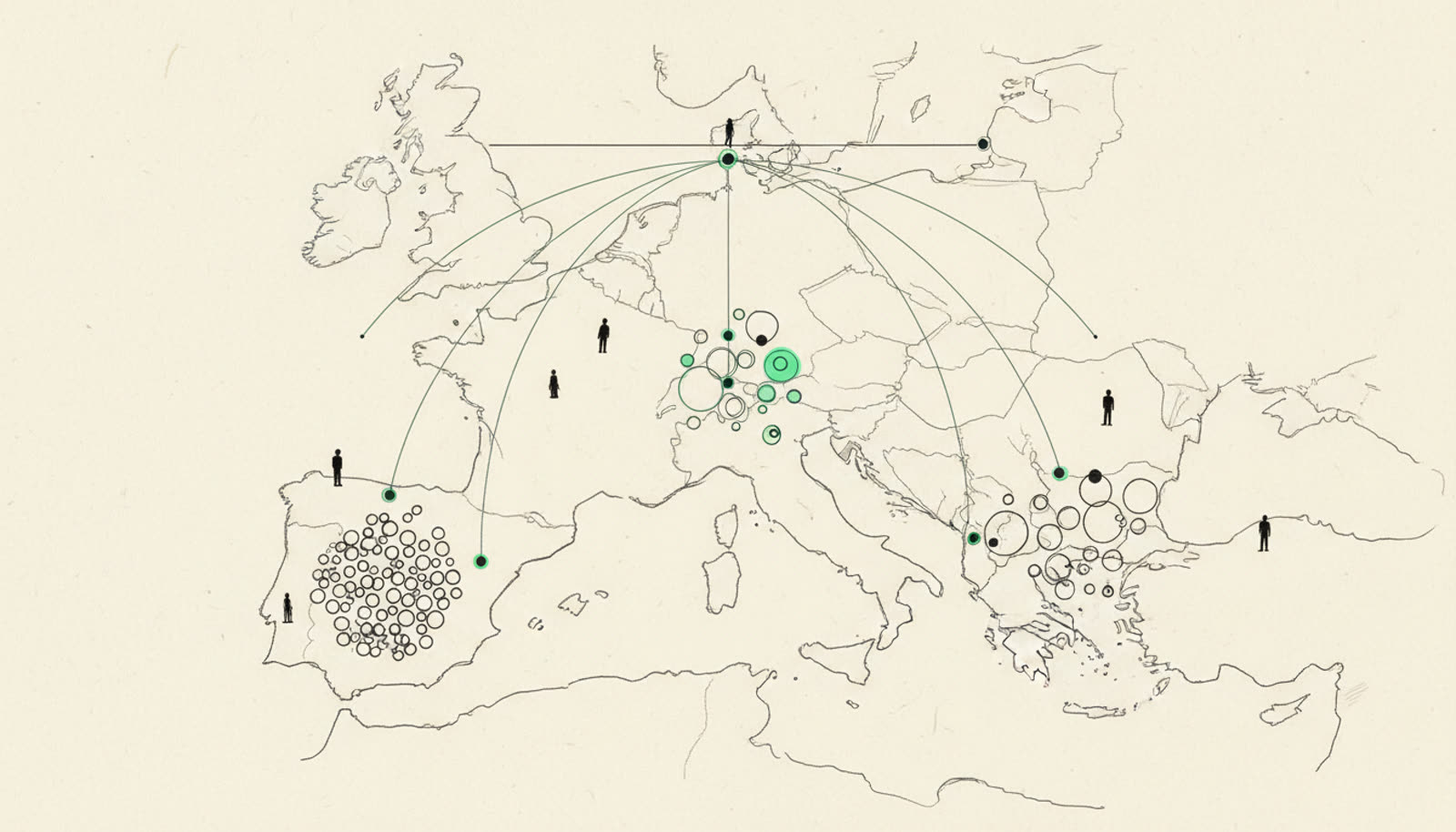
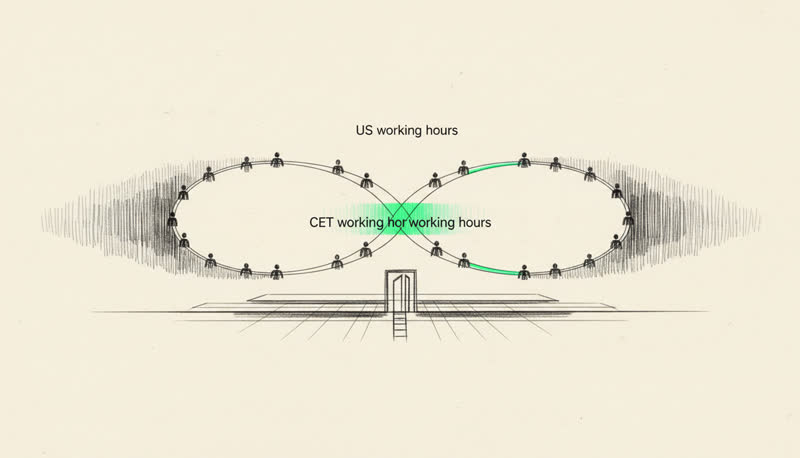
Poland, Romania, and Kosovo all sit close to Central European Time, giving meaningful overlap with Western Europe's working day and partial overlap with US East Coast mornings. They differ on talent pool depth and wage level: Poland is largest and most established, Romania sits in the middle on cost, and Kosovo is the smallest market with the lowest wage floor.
What the time zone overlap actually buys you
None of this is a reason to pick one country over another on its own. A team in Warsaw, Bucharest, or Pristina can join a 10am London call or a late-afternoon New York call without anyone starting work at midnight, which is the real argument for hiring across this band rather than further offshore. We treat that overlap as a baseline requirement, not a differentiator, when we search these three regions. The guide to building a distributed team across US and CET time zones covers how teams structure a working day around that overlap. What the clock does not tell you is whether a market has the engineering depth, specialization, or price point your role needs, and that is where Poland, Romania, and Kosovo genuinely separate.
Poland: the largest and most established of the three
Poland placed among the top ten countries by respondent share in the 2024 Stack Overflow Developer Survey, at 2.6 percent of the roughly 34,500 respondents who disclosed a country, or 1,528 individual responses. When we search Poland for an engineering role, that respondent count is the first signal we read: a market with real depth across specializations, not just a handful of strong engineers concentrated in one city.
The wage data backs up the maturity read. Statistics Poland (GUS) reported that in March 2024, the Information and Communication section carried the highest average wage of any economic section in the country, at nearly 15,000 PLN per month (median 10,558.90 PLN). That compares to a national average monthly gross wage of 8,604.72 PLN across all economic sections that same month. Information and Communication is not just a well-paid sector in Poland, it is the best-paid sector, full stop, which is a reasonable proxy for a market where engineering talent is priced competitively against every other profession, not treated as a discount line item.
Romania: a smaller pool at a lower labor cost
Romania showed a noticeably smaller footprint in the same survey, at 0.8 percent of respondents (436 responses) in the 2024 Stack Overflow Developer Survey, roughly 3.5 times fewer responses than Poland. That is still a functioning engineering market, just a shallower one to search against for a highly specific or senior profile, and we calibrate expectations around that before we open a search there.
On cost, Eurostat's 2024 data put Romania's average hourly labor cost across the whole economy at 12.5 euros, among the lowest figures recorded in the EU that year, and up 14.2 percent from 2023 in national-currency terms. That whole-economy figure is not an engineering-specific wage, and wages move faster than the economy-wide average suggests, but it is a useful signal that Romania's overall cost base sits well below Western European levels even as it climbs.
Kosovo: the smallest market, and the clearest wage gap
Kosovo is the smallest of the three markets, both in population and in engineering talent depth. The Kosovo Agency of Statistics reported an average national gross wage of 713 euros per month in 2025, up 11.6 percent from 639 euros in 2024. Within that economy, Information and Communication was the highest-paid economic activity, at 1,216 euros gross per month, roughly 1.7 times the national average wage.
That sector premium (IT pays meaningfully more than the average job in Kosovo, same as it does in Poland) tells us engineering is a desirable career path there too. But 1,216 euros gross sits well below Poland's Information and Communication wage level, and that gap reflects a smaller, less mature, lower-cost engineering market relative to Poland rather than a simple discount on the same talent. We cover what that smaller pool means in practice for sourcing and calibration in the walkthrough of how we run a developer search across the Balkans and Eastern Europe.
Comparing the three markets side by side
| Country | Talent pool signal (2024 Stack Overflow Survey) | Wage signal | Market read |
|---|
| Poland | 2.6% of respondents, 1,528 responses | GUS: Info/Comm avg. nearly 15,000 PLN/mo (median 10,558.90 PLN) vs. national avg. 8,604.72 PLN | Largest, most established; IT is the best-paid sector in the economy |
| Romania | 0.8% of respondents, 436 responses | Eurostat: avg. hourly labor cost (whole economy) 12.5 euros, up 14.2% vs. 2023 | Smaller pool than Poland, lower overall labor cost, rising fast |
| Kosovo | Smallest of the three markets | Kosovo Agency of Statistics: national avg. 713 euros/mo (2025), Info/Comm 1,216 euros/mo | Smallest and least mature engineering market; lowest wage floor of the three |
What this means for a hiring decision
None of this ranks one country as the right answer for every role. A founder hiring a single senior backend engineer with a narrow specialization is usually better served by Poland's larger, more established pool, where the 2024 survey's respondent count alone suggests more candidates at the top of the distribution. A team building out a broader engineering function at lower cost, where Romania's labor-cost position is attractive and the talent pool, while smaller than Poland's, is still functioning, may calibrate differently. Kosovo suits a specific case well: teams that have already found strong individual engineers there (through referral, a developer community, or a prior search) and want to build around that, rather than teams expecting a deep bench of candidates to choose from on day one.
None of these three datasets requires a search partner to read. If you already have applicant flow for a Polish backend role, or a referral into Kosovo's small developer community, post the role and run interviews yourselves; a search firm does not add much when the pool is visible and the spec is clear. What we add is calibration where the pool is shallower or the spec is narrower: translating what the role actually needs into where to look and who to approach, rather than widening a search in a market that simply does not have the depth a role requires.
The honest caveat in all three cases is that none of these figures are engineering-specific wage surveys. GUS and the Kosovo Agency of Statistics both report sector-level averages for all of Information and Communication, which includes roles well beyond software engineering, and Eurostat's Romania figure is a whole-economy hourly labor cost, not a developer salary. They are the best publicly available proxies for where each market sits, not a substitute for calibrating comp against the specific role, seniority, and specialization we are hiring for. We go into how that calibration happens before a search starts in the piece on hiring engineers and AI talent and the walkthrough of how we run an international AI engineer search.
The short version
Poland, Romania, and Kosovo all sit close enough to Central European Time to overlap comfortably with a Western European working day and partially with US East Coast mornings, but they are not interchangeable talent markets. Poland is the deepest pool and the most expensive of the three, with Information and Communication as its best-paid economic sector. Romania sits in between, with a smaller surveyed developer pool and a lower whole-economy labor cost. Kosovo is the smallest market with the lowest wage floor, including its own highest-paid sector at 1,216 euros gross per month. The right market depends on the role's seniority and specialization more than on geography alone, which is exactly what a calibration call is for before we run a search against any of these three regions.
 Recruit