Building a Distributed Team Across US and CET Time Zones
CET and the continental US barely share a working day, which breaks the assumption that a distributed team can just meet whenever. This piece maps the actual overlap hours and shows how to structure a team that spans both without forcing anyone into a permanent night shift.
Central European Time and the continental United States share almost no standard working day: the only real overlap sits where CET's afternoon meets the US East Coast's morning. A team spanning both needs a deliberate split, a short list of protected live hours, and an asynchronous default for everything else, not an assumption that a meeting time will turn up.
Key numbers
CET runs UTC+1 on standard time, UTC+2 during Central European Summer Time.
US Eastern Time sits 6 hours behind CET on standard time, 5 hours behind during US daylight saving.
US Central Time sits 7 hours behind CET, and US Pacific sits 9 hours behind, both on standard time.
Oyster's overlap framework: teams still building async habits do better hiring into zones with 5 or more hours of daily overlap; teams comfortable operating asynchronously can extend into zones with as little as 1 hour.
Kosovo, home to our sister brand HireKosovo.com, runs on CET, along with several countries across the Western Europe, Balkans and Eastern Europe regions we search.
What "CET and the continental US" actually means
CET is not one country's clock. It covers most of continental Europe, which means a CET hire could sit in Western Europe, the Balkans, or Eastern Europe, three of the six regions we search. Kosovo, where our sister brand HireKosovo.com focuses, also runs on CET, which is part of why Balkans hiring and CET scheduling questions tend to arrive together.
The continental US is not one clock either. A company anchored on the East Coast has a materially different overlap problem than one anchored in Chicago or Denver or San Francisco, even though all three are "the US" in a job post. The honest starting point for any US-CET team is to work out which specific US time zone the business is actually anchored in, because the gap to CET changes by an hour or two depending on the answer, and that difference decides whether a live standup is realistic at all.
The offset math, precisely
On standard time, CET sits at UTC+1. During Central European Summer Time it moves to UTC+2. Measured against that:
US Eastern Time sits 6 hours behind CET on standard time, 5 hours behind during US daylight saving.
US Central Time sits 7 hours behind CET on standard time.
US Pacific Time sits 9 hours behind CET on standard time.
The Eastern gap narrows because the US and the EU do not move their clocks on the same calendar date: for a few weeks each spring and fall, one side is on daylight saving while the other is not. US Central and Pacific sit 7 and 9 hours behind CET on standard time to begin with, and a shift of an hour in either direction does not produce a realistic standard-hours overlap at that distance.
What the gap costs you, zone by zone
Assume, for illustration, a standard 9-to-5 local workday on each side. That is a labeled assumption, not a universal fact, but it is the cleanest way to see what the offset actually does to a shared calendar.
US zone
Gap from CET
What a 9-to-5 day on both sides leaves you
Eastern
6 hours behind on standard time, 5 during US daylight saving
A narrow band where CET's afternoon meets Eastern's morning, about 2 hours under the 9-to-5 assumption
Central
7 hours behind
A thinner version of the same band, about 1 hour under the 9-to-5 assumption
Pacific
9 hours behind
No standard-hours overlap at all under the 9-to-5 assumption
Eastern is the only US zone with a realistic sliver of shared standard hours, and even that sliver sits at the edges of both days, early for the American and late for the European.
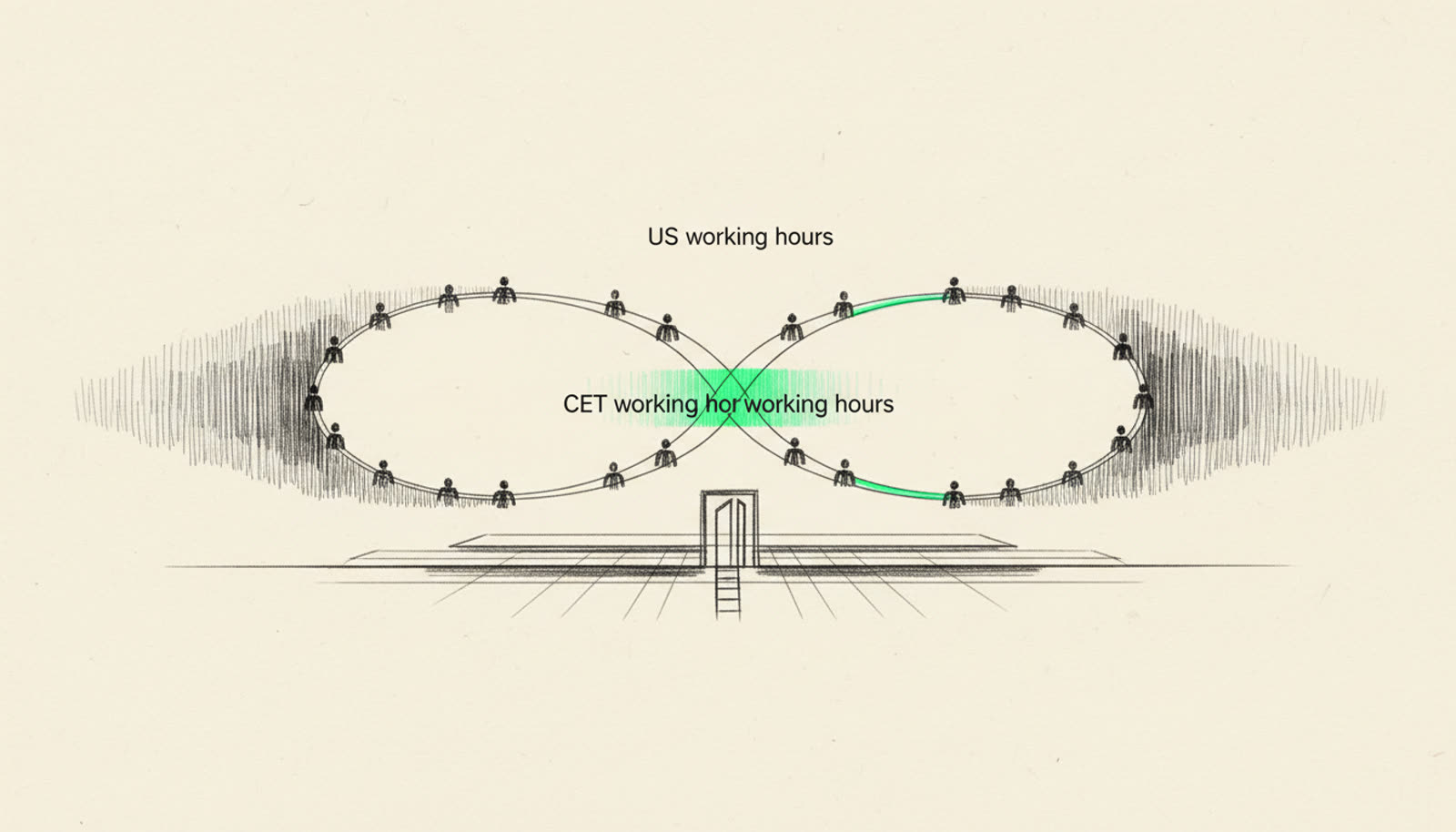
Here is the same math as a picture, on one UTC clock.
Even the brightest band here, CET and Eastern, is about two hours wide under the 9-to-5 assumption, sitting at the edge of CET's afternoon and the very start of Eastern's morning. That is the entire shared standard-hours window between the two largest hiring pools on either side of this piece. Everything else has to be designed around it, not assumed into existence.
Live hours versus async default
Deel's guidance for global remote teams is direct on this point: schedule the essential meetings inside whatever overlap actually exists, and build the rest of the day around asynchronous work rather than trying to force a shared schedule where none exists. Centralizing documentation, so that decisions and context live in a shared, written record rather than in people's heads, matters more here than it does for a team sharing a single time zone, because no one can assume a colleague will be online to answer a quick question.
For a US-CET team, we would split the working structure into two deliberate layers.
The live layer. A small number of meetings, chosen because they genuinely need real-time discussion, scheduled inside the narrow Eastern-CET band. This usually means a handful of recurring touchpoints, not a full meeting calendar: a weekly sync with leadership on both sides, a scoped planning session at the start of a sprint or project phase, and anything that is a live negotiation rather than a status update.
The async default. Everything else runs on written handoffs. Standups become a shared document updated by end of day, not a call. Decisions get written down with the reasoning attached, not just the outcome, so a colleague working CET hours who was asleep when a call happened can read the decision and act on it without waiting for someone to wake up and explain it again. Code review, design feedback, and project status move through comments and recorded context rather than synchronous conversation.
The failure mode to watch for is a team that writes "async-first" into its values and then schedules five meetings a week inside the only overlap window there is, burning the entire shared hour or two on status updates that could have been a document. The overlap is scarce. Spend it on the things that actually require two people talking in real time.
How much overlap do you actually need
Oyster frames this as a question of team maturity rather than a single fixed rule, and the framing is useful because it keeps teams from either over-restricting their hiring map or under-preparing for the hiring they want to do.
Team maturity
Recommended daily overlap
What that means for a CET hire
Newer to distributed work, or still building async habits
5 or more hours
A CET hire likely needs to sit closer to the US side's working hours than a typical Eastern European workday allows, or the US side needs to shift significantly earlier
Comfortable operating asynchronously, strong documentation habits already in place
As little as 1 hour
A CET hire can run close to a standard local day, with only a thin, well-used live window connecting the two sides
A team early in its distributed-hiring experience, without established documentation habits, should not assume it can hire into CET and run on an hour of overlap. That hour has to be enough to resolve every ambiguity, every blocked decision, every piece of context a written handoff did not fully capture, and a team that has not yet built the muscle for that will feel the gap immediately. Teams that have already built strong async habits, clear written decisions, a documentation system people actually use, a culture of writing status instead of reporting it live, can extend their hiring map further, because the thin overlap is enough to cover the handful of things that genuinely need two people talking.
For a US-anchored company hiring into CET, the practical read is this: treat the Eastern-CET band as reserved for what truly needs everyone live, and build standups, handoffs, and most decisions around asynchronous documentation rather than a shared workday, because against Central and Pacific anchors, that shared workday barely exists at all.
Where the CET side of the team actually comes from
CET spans a wide hiring map. A company building out engineering, product, or growth capacity on the CET side has real choices between Western European markets, the Balkans, and Eastern Europe, and those choices differ on cost, specialization, and candidate availability in ways that matter more than the time zone question once the overlap structure is settled. The comparison between hiring engineers in Poland, Kosovo, and Romania is a useful next step once a company has decided it wants a CET-based engineering hire and needs to pick a specific market.
Kosovo sits inside this picture directly: it runs on CET, and it anchors HireKosovo.com, our sister brand under the Recruitmint umbrella. A company building a distributed team that includes Balkan engineering talent is working the same overlap math described above, since the Balkans fall inside CET along with the rest of continental Europe. We describe exactly how that kind of search runs, from calibrating what the role needs through to a shortlist, in how we run a search for developers in the Balkans and Eastern Europe.
For a company doing this for the first time, the broader mechanics of hiring across a border, compliance, contracts, how a search firm structures the work, are covered in the guide to how international recruitment agencies operate. The time zone question is one layer of a US-CET hire; the legal and operational layer is a separate, equally real one.
When this structure fits, and when it does not
A deliberate live-hours-plus-async split is worth building when a company is hiring more than a handful of roles into CET, expects that hiring to continue, and needs the team to function as one operation rather than two loosely connected offices. It also fits when the roles involved genuinely require cross-timezone collaboration: a founding engineer working alongside a US-based product lead, a growth team split between a US-based performance marketer and a CET-based creative or ecommerce operator.
It does not fit, and is not worth building, when a company has one clearly scoped CET role with limited need for daily back-and-forth with the US side. A single well-defined hire with a documented process and minimal dependency on live collaboration does not need a time zone framework; it needs a calibrated shortlist and a hiring manager with time to interview. Building a whole async infrastructure around one hire is more process than the problem calls for.
Where a company is managing several open CET roles at once, the volume itself is often the better reason to bring in dedicated recruiting capacity rather than running each search independently, the difference between occasional sourcing support and an embedded partner model working as an extension of the hiring team across every open role. We built the Hiring Scorecard around exactly this kind of volume question, scoring role clarity, hiring readiness, talent market fit, and recruitment capacity before recommending a model.
Checklist: before you build the US-CET split
Criterion
What "strong" looks like
Weight
Evidence to ask for
Meeting cadence
A short, named list of meetings that must be live, nothing else defaults to synchronous
High
The current meeting calendar, with each recurring meeting justified against a specific decision it has to make
Documentation habits
Decisions are written down with reasoning, not just outcomes, in a place everyone checks
High
A sample of recent written decisions from the last month
Management coverage
Someone with authority is reachable during both halves of the working day, not just the US side
Medium
Who currently answers a blocked question when the US side is asleep
Hiring pipeline into the CET market
A defined region (Western Europe, Balkans, or Eastern Europe) with a realistic candidate pool for the role
Medium
A completed talent map or sourcing pass for the specific role and region
Role clarity for a distributed hire
The role's scope, decision rights, and success criteria are written down before the search starts
High
A calibration document the hiring manager can hand to a recruiter or a new hire on day one
The short version
CET and the continental US share, at most, a couple of standard hours between CET's afternoon and the US East Coast's morning, and close to nothing against the Central or Pacific coasts. Building a distributed team across that gap means reserving the thin overlap for the meetings that truly need everyone live, Deel's core guidance, and defaulting everything else to written, async work. Oyster's maturity framework gives a concrete target: 5 or more hours of overlap if the team's async habits are still forming, as little as 1 hour once they are not. For the CET side of that team, Western Europe, the Balkans, and Eastern Europe are the markets in play, and the choice between them is a separate decision from the time zone problem this piece covers.
FAQ
Is there any real overlap between CET and the US at all?
Yes, but it is narrow and sits only against US Eastern Time. On standard time, CET is 6 hours ahead of Eastern (5 during US daylight saving), which leaves a window late in CET's day meeting early in Eastern's day. Against US Central the window is thinner, and against US Pacific there is effectively no standard-hours overlap at all.
Should we just hire everyone in CET on US hours instead?
That trades the time zone problem for a different one: a CET-based employee working a US schedule is working evenings and nights in their own time zone, which is a harder ask to sustain than building an async default. Deel's guidance points the other way, schedule the few essential meetings inside the real overlap and let the rest of the day run on each side's own local hours, supported by written documentation rather than live presence.
How much daily overlap do we actually need to make this work?
Oyster's framework ties the answer to team maturity rather than a fixed number: teams still building async habits do better with 5 or more hours of daily overlap, while teams with strong documentation and async discipline already in place can operate with as little as 1 hour. Most US-CET pairings sit closer to the low end of that range by default, since the real overlap against Eastern is only around two hours under a standard workday assumption, and against Pacific is close to none.
Does it matter which part of CET we hire into?
Not for the time zone math, since Western Europe, the Balkans, and Eastern Europe all run on CET, but it matters for everything else. Candidate availability, specialization, and typical compensation vary by market, which is why a company choosing between, say, Poland, Kosovo, and Romania for an engineering hire should treat that as a separate decision from the overlap question.
A criteria-first look at international recruitment agencies startups actually consider, including Recruitmint, with the stated basis for inclusion and a link to each firm's own site.
A founder's first hire in a new country usually comes down to one decision: engage them as an independent contractor, or bring them on as a formal employee through an entity or an Employer of Record. This piece lays out the misclassification risk behind that choice using published penalty and case data.
Hiring someone abroad usually means choosing between an Employer of Record and a contractor agreement. Here is how the two actually differ in cost and structure, cited to the EOR providers' own pricing pages.
 Recruit