GovMint·Government contracting·pillar·August 27, 2026·12 min read
Security Clearance Levels Explained for Hiring Managers
The federal government sorts classified access into three eligibility tiers, Confidential, Secret and Top Secret, plus a narrower compartmented layer above Top Secret. This piece breaks down what each tier actually requires and why the tier written into a job requisition changes the size of the candidate pool before a search even starts.
Confidential, Secret and Top Secret are the three eligibility tiers the federal government sorts classified access into, each defined by the damage unauthorized disclosure could cause. Eligibility is not the same as access: a cleared candidate only sees information tied to a genuine need to know. Sensitive Compartmented Information sits above Top Secret as an add-on layer, not a fourth tier.
Key numbers
Three eligibility tiers exist under Executive Order 13526: Confidential, Secret and Top Secret, each defined by a distinct damage standard (National Archives ISOO, Executive Order 13526).
Sensitive Compartmented Information sits on top of a Top Secret eligibility rather than replacing it, per NIST's glossary definition drawn from CNSSI 4009.
GAO's 2026 review of the government-wide personnel security clearance process found that more than 60 percent of the FY2024 data it examined, across eight reporting requirements and seven agencies, was inaccurate or incomplete (GAO-26-107100).
Within that same review, 86 percent of the timeliness data specifically was inaccurate, with agencies confirming their reported processing times had understated the real duration of the process (GAO-26-107100).
What Confidential, Secret and Top Secret actually mean
The three-tier structure comes from Executive Order 13526, the current framework federal agencies use to classify national security information. Each tier is not a rank of trust in the abstract. It is a statement about consequence: how much damage a specific piece of information would cause the government if it were disclosed without authorization.
Confidential covers information where unauthorized disclosure "reasonably could be expected to cause damage" to national security. Secret covers information where disclosure could cause "serious damage." Top Secret covers information where disclosure could cause "exceptionally grave damage." The words scale up deliberately, and the vetting scales with them.
This matters for a hiring manager because a clearance level is not a badge. It is a prediction the government has made, based on background investigation, about whether a specific person can be trusted with a specific category of consequence. A job requisition that specifies a clearance level is really specifying an investigation depth and a pool of people who have already cleared it, or who are eligible to be sponsored through it.
The damage standard behind each tier, and what it does to your pool
The higher the damage standard, the deeper the background investigation, and the smaller the number of people who hold or can reasonably be sponsored for that eligibility. The relationship is not linear. It compounds, because each tier up also tends to require the tier below it as a foundation, plus additional scrutiny layered on top.
Tier
EO 13526 damage standard
What the investigation typically involves
Effect on candidate pool
Confidential
Disclosure could cause damage to national security
The lightest tier of the three; still requires a background check before eligibility is granted
Far larger pool of eligible candidates than the tiers above it
Secret
Disclosure could cause serious damage to national security
A more thorough investigation than Confidential, reviewing a longer history and wider set of records
Smaller pool than Confidential; still broad enough for many technical and program-support roles
Top Secret
Disclosure could cause exceptionally grave damage to national security
The most extensive vetting of the three tiers before eligibility is granted
Smallest of the three pools, and the one where sourcing takes the most deliberate work
A role requiring Confidential access draws from a far larger pool of clearance-eligible candidates than one requiring Top Secret. That is the practical fact underneath the legal language, and it is the fact that changes how a search actually runs. Writing "Top Secret required" into a requisition when the role genuinely only touches Secret-level material does not make the hire more secure. It makes the search smaller, slower and more expensive for no operational reason.
SCI and special access: an add-on layer, not a fourth tier
Sensitive Compartmented Information, as NIST's glossary defines it (drawing on CNSSI 4009), is classified information tied to intelligence sources, methods or analytical processes, handled inside formal access-control systems established by the Director of National Intelligence. SCI sits on top of a Top Secret eligibility. It does not stand beside Confidential, Secret and Top Secret as a fourth rung on the same ladder.
Two things follow from that structure. First, nobody is "SCI eligible" without already holding Top Secret eligibility as the base. Second, SCI is granted for a specific need-to-know inside a specific compartmented program, not as a general credential. A candidate can hold Top Secret eligibility and never be read into a given SCI program, because access within a compartment is decided program by program, not tier by tier.
Special Access Programs work on a similar logic: an additional layer of control above standard classification, applied to a narrower population for a narrower purpose. For a hiring manager, the effect is the same as it is for SCI. Every layer added above Top Secret narrows the realistic candidate pool further, and it usually adds time to the front end of a search rather than the back end, because eligibility and program access have to be confirmed before a candidate can be seriously evaluated for the role.
Locking the level in during calibration, not after sourcing starts
The single most avoidable mistake in a cleared search is deciding the clearance level after sourcing has already begun. It looks efficient to post the requisition and figure out the exact tier while candidates are already being screened. It is the opposite. Every hour a search runs against the wrong tier is an hour spent evaluating people who are ineligible, unavailable, or already committed elsewhere, and every correction mid-search resets the pipeline.
The tier belongs in role scoping, alongside the other decisions that determine whether a search is realistic: the program's actual access requirements, the facility or system the role will touch, whether the position is CONUS or OCONUS, and what the contract itself specifies. This is the same discipline described in our piece on what a calibration call actually covers: the harder part of a search is not finding candidates, it is understanding precisely what the business needs before anyone starts looking.
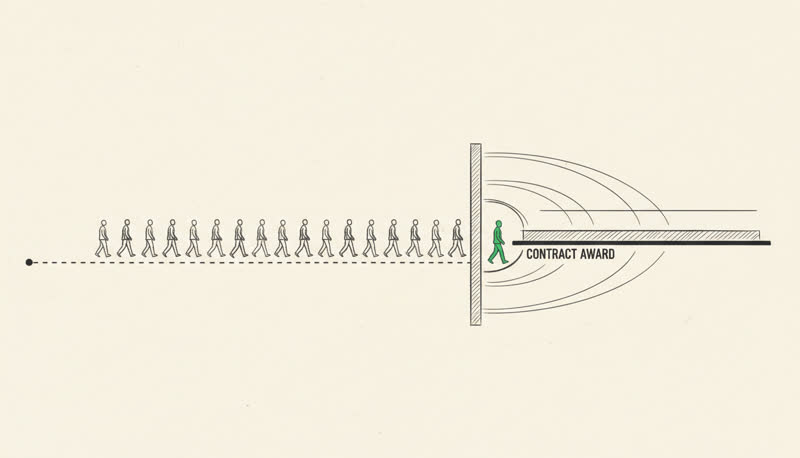
For government contractors specifically, this calibration step often has to happen faster than in commercial hiring, because the clock on delivery starts at contract award, not at the first day of mobilization. Our guide to award-driven hiring for government contractors covers how program scope, location and delivery phase translate into workforce demand. Award-to-Hire Intelligence, described on the government contracting page, follows a simple three-step signal: a contract is awarded, a workforce signal is identified from the program's scope and location, and a search can be activated before hiring becomes a bottleneck. The clearance tier is one of the first facts that has to be locked at step two, because it decides whether step three targets a broad pool or a narrow one.
The pattern for how that plays out on a cleared search, from calibration through candidate qualification, is walked through in how a cleared talent search runs after contract award. The core lesson is the same one this piece is making: get the tier right before the search opens, not after.
When each tier fits, and when it does not
Not every program role needs the highest tier the contract as a whole carries. A program can hold a Top Secret facility clearance while most of the roles inside it only require Secret, or even Confidential, because most of the people on a delivery team are not touching the most sensitive material directly.
Situation
Tier that usually fits
Why
Program support, logistics, general administrative roles on a cleared program
Confidential or Secret, depending on the specific duties
Broadest pool; investigation depth matched to actual exposure
Technical or engineering roles working inside classified systems but outside intelligence-specific work
Secret or Top Secret, depending on system access
Narrower pool, but still realistic without SCI
Roles working with intelligence sources, methods or analytical products inside a defined compartment
Top Secret plus SCI
Narrowest pool; requires program-specific access decided separately from the base tier
Roles where the actual duties do not touch classified material at all
No clearance, or a lower tier than the contract's ceiling
Writing a higher tier into the requisition only shrinks the pool without a security benefit
The mistake runs in both directions. Under-specifying the tier creates a compliance problem when the successful candidate cannot actually be read into the work. Over-specifying it creates a sourcing problem: a smaller pool, longer time before an offer can even be discussed, and candidates who hold the tier but are not otherwise a fit for the role, because the search has been artificially narrowed to "anyone eligible" rather than "the right person who is also eligible."
Why published clearance timelines deserve skepticism
Hiring managers planning a program's mobilization date often ask for a specific number: how many days or months a Secret or Top Secret investigation takes. The honest answer is that any specific figure should be treated as a planning input to verify, not a guarantee.
GAO's 2026 report on the government-wide personnel security clearance process examined FY2024 data across eight reporting requirements and seven agencies, and found more than 60 percent of it inaccurate or incomplete. Within that same review, 86 percent of the timeliness data specifically was inaccurate, and agencies confirmed that their reported processing times had understated how long the process actually took (GAO-26-107100).
That finding does not mean clearance processing is arbitrary. It means the numbers agencies themselves report are not reliable enough to build a hiring timeline around without a margin. A hiring manager who builds a mobilization date around a specific published processing figure, without a buffer, is building it on data GAO itself found was more likely wrong than right. The safer approach is to treat any timeline a contracting officer or agency representative offers as a starting estimate, confirm it against the specific program and investigation type, and build schedule margin around it rather than against it.
A calibration checklist for scoping the clearance requirement
Criterion
What "strong" looks like
Weight
Evidence to ask for
Actual duties vs. contract ceiling
The role's real day-to-day work, not the program's highest clearance level, sets the requirement
High
A duties description mapped against the specific systems or material the role touches
Base tier vs. compartmented add-on
The requisition distinguishes Top Secret eligibility from any SCI or SAP need clearly
High
Confirmation from the program security officer on whether compartmented access is required
Sponsorship path
Whether the contractor can sponsor an investigation, or must fill only with already-cleared candidates, is decided before sourcing starts
High
A written answer on sponsorship capacity for the specific tier
Location and delivery phase
The tier requirement is checked against where the role sits (CONUS or OCONUS) and when delivery starts
Medium
Program schedule and location details from the award
Timeline assumption
Any processing-time figure used for planning is treated as an estimate with a buffer, not a fixed date
Medium
The source of the timeline figure and whether it has been confirmed with current guidance
This checklist belongs in the same conversation as SDVOSB and set-aside hiring basics for contractors working inside federal socioeconomic set-asides, and it applies whether the search is run in-house, through a Sourcing Sprint for a single well-defined role, or through broader recruitment capacity for multiple roles opening across a program at once. The Hiring Scorecard asks about role clarity and hiring readiness precisely because an unclarified requirement, clearance tier included, is one of the most common reasons a search takes longer than it should.
The short version
Confidential, Secret and Top Secret are eligibility tiers tied to a damage standard under Executive Order 13526, each one narrowing the pool of eligible candidates further than the one below it. SCI and other special access programs sit on top of Top Secret as an add-on layer, granted program by program, not as a fourth tier on the same ladder. Lock the actual tier the role requires, distinct from the program's ceiling, during calibration rather than mid-search, and treat any specific clearance processing-time figure as an estimate to verify given how unreliable GAO found that data to be in its 2026 review.
FAQ
What is the difference between Secret and Top Secret clearance for hiring purposes?
Secret covers information where unauthorized disclosure could cause serious damage to national security, while Top Secret covers information where disclosure could cause exceptionally grave damage, under Executive Order 13526. For a hiring manager, the practical difference is investigation depth and pool size: Top Secret involves the most extensive vetting of the three tiers and draws from a smaller pool of eligible candidates than Secret does.
Is SCI a higher clearance level than Top Secret?
SCI is not a separate, higher tier in the way Confidential, Secret and Top Secret are tiers of each other. It is an add-on layer that sits on top of a Top Secret eligibility, granted for a specific need-to-know inside a formal, compartmented access-control system established by the Director of National Intelligence. A candidate needs Top Secret eligibility as the foundation before SCI access is even considered.
Should we write "Top Secret required" into every requisition on a classified program?
Not unless the role's actual duties require it. A program can hold a facility clearance at Top Secret while most roles inside it only need Secret or Confidential access based on what they actually touch. Writing a higher tier than the work requires narrows the candidate pool without a corresponding security benefit, and it usually slows the search down.
Can we trust a published clearance processing time when planning a mobilization date?
Treat any specific processing-time figure as a planning input to verify, not a guarantee. GAO's 2026 review of government-wide clearance data found more than 60 percent of the FY2024 data it examined was inaccurate or incomplete, and 86 percent of the timeliness data specifically was inaccurate, with agencies confirming their reported figures had understated the real duration of the process (GAO-26-107100).
When does the clearance tier need to be decided in the hiring process?
During role scoping and calibration, before sourcing starts. Deciding the tier after candidates are already being screened means restarting the search against a different pool, which is the most common and most avoidable delay in cleared hiring.
How recruiting for government contractors differs from commercial hiring, what Award-to-Hire Intelligence means, and where the clearance and procurement facts below come from. Every procurement or clearance figure is cited to a federal source.
A government contract Program Manager hire is often bottlenecked by clearance timelines, not available talent. This guide covers what the role owns, what to evaluate, and how to time the search against contract award.
How Award-to-Hire Intelligence turns a contract award into an earlier-starting cleared-talent search, described as Recruitmint's general process pattern, not a specific past engagement.
 Recruit