 Recruit
Remote Hiring Across Time Zones: A Practical Playbook
A framework for structuring overlap hours, async handoffs, and interview scheduling so a distributed team actually functions across multiple time zones.
A framework for structuring overlap hours, async handoffs, and interview scheduling so a distributed team actually functions across multiple time zones.

A distributed team works across time zones when three things are built on purpose: an overlap window scoped to real decisions, a default of async handoffs for everything that is not a decision, and an interview process that treats time zones as a scheduling variable to solve early. Past two or three zones, none of this happens by accident.
Key numbers
Hiring remote people and running a team across time zones are two different problems. The first is a sourcing question: can the role be done from anywhere, and will the company sponsor or contract across borders. The second is an operating question: once someone in Lisbon, someone in Austin and someone in Dubai are all on the same team, how does work actually move between them without every decision waiting for a meeting that three of the four people are asleep for.
This piece is about the second problem. It covers how to size an overlap window, how to default to async handoffs outside it, and how to schedule interviews so the process itself does not quietly filter out strong candidates in the "wrong" time zone. It assumes the hiring decision (remote, which regions, which role) has already been made or is close to it.
We have said elsewhere, and it is worth repeating here: hiring standards, candidate markets, compensation expectations and operating environments vary significantly by region, which is why we calibrate searches to each market's realities rather than run the same approach everywhere. The same logic applies to how a distributed team operates once people are hired.
A Western European engineer, a Balkans-based developer, a Middle East-based program lead and a Latin America-based ops hire are not just in different time zones. They are often in different regulatory environments, different norms around working hours and availability, and different expectations about how much of a role happens synchronously versus on a deliverable basis. A time-zone process built only around clock hours and ignoring those differences tends to break down the same way a hiring process built around one region's comp expectations breaks down when applied somewhere else.
This is the practical argument for designing overlap hours, handoffs and interview scheduling by region rather than writing one policy and extending it to every hire. Pairs that sit closer together on the clock can usually sustain more live collaboration without much personal cost. Pairs with a wide gap, where a normal workday on one side falls mostly or entirely outside the other side's waking hours, push more of the working relationship into written handoffs by default, not by preference.
No published industry framework exists for exactly how many hours of overlap a distributed team needs, how an async handoff should be written, or how to schedule interviews fairly across six or more time zones. Our own material and the Hiring Scorecard do not contain one either. What follows is a practical framework built from how distributed hiring and team operations function in practice, offered as working guidance rather than a benchmark pulled from a study.
The mistake most teams make is treating overlap as a social good rather than a design constraint. More overlap feels collaborative. It is also the thing that erodes first when a team spans several zones, because someone is always trading sleep or family time for it.
A more durable approach: scope the overlap window to the decisions that actually require two people live at once, not to general availability.
Async-first is not the absence of a process. It is a different process, and it fails just as badly as a synchronous one when it is left implicit.
A handoff that works has three parts: what was done, what is still open, and what decision (if any) the next person needs to make. Without the third part, a handoff becomes a status update that the receiving person has to interpret, which reintroduces the real-time dependency the handoff was meant to remove.
A practical pattern:
The region-specific wrinkle: a handoff between two teams with only an hour or two of separation, say within Western Europe, the Balkans and Eastern Europe, can tolerate more informality because a same-day reply is realistic. A handoff crossing a wide gap, for example a Western Europe team working with Latin America, or North America working with the Middle East, usually cannot, because the reply may not land until the next working day. The more distant the pair, the more the handoff needs to carry its own decision logic rather than assume a quick clarifying question is possible.
Interview scheduling is where time-zone friction shows up earliest and most visibly, because it happens before the candidate has joined anything. A process that defaults to "whatever time works for the hiring manager" quietly filters for candidates willing to take a call at an inconvenient hour, which is not the same thing as filtering for the strongest candidate.
A workable structure:
This is a structure we rely on, not a formula with one right answer, built from how scheduling friction actually shows up once a search starts reaching across regions.
The diagram is a shape, not a timetable. Actual offsets depend on the specific country, the time of year, and daylight saving rules that shift most regions by an hour at different points in the calendar, so no fixed clock times are asserted here. The point it makes holds regardless of the exact hours: once a team spans three or more regions with meaningfully different workdays, the window where everyone is awake and working shrinks, which is the entire argument for building the overlap, handoff and interview structure deliberately rather than leaving it to whichever meeting gets scheduled first.
There is no dollar cost to compare here; the cost of a time-zone structure is paid in coordination overhead, decision latency, or someone's working hours. Three common structures, and what each one actually costs:
| Structure | Overlap required | Main operational cost | Best fit |
|---|---|---|---|
| Full overlap | Most of a standard working day | Someone on one side works outside normal hours most days | Pairs within a few hours of each other, or roles with heavy live collaboration |
| Core overlap window | One to three hours, scoped to decisions | Discipline to keep the window for decisions, not status | Most cross-region pairs with regular but not constant live dependency |
| Async-first | Little to none, optional live check-ins | Slower resolution on anything that turns out to need a decision after all | Pairs with little or no daytime overlap, or roles that are largely deliverable-based |
A formal overlap-window, handoff and scheduling structure earns its keep once a team has people in three or more of the regions we search in regularly: Western Europe, North America, the Balkans, Eastern Europe, the Middle East and Latin America. At that point, informal "just message them" coordination starts producing the same friction repeatedly: decisions waiting a full day, interview slots that quietly favor whichever candidate is willing to take an inconvenient call, status updates mistaken for decisions.
It is not worth building for a single remote hire added to an otherwise co-located team, or for a company hiring one role in one region with daytime overlap close to full. In that case, a shared calendar and a habit of writing things down is enough; a published overlap-window policy and a formal handoff template will mostly go unused.
This is close to the same judgment the Hiring Scorecard asks for directly, in its question about openness to international hiring: wherever the strongest candidate is, within specific regions, remote candidates only, or one specific location. A company that answers "wherever the strongest candidate is" across several regions is answering yes to needing a time-zone process. A company that answers "one specific location" usually is not, yet. Running through that self-assessment before building anything is a reasonable first step, and we built the Hiring Scorecard to surface exactly that answer in a couple of minutes.
| Criterion | What "ready" looks like | Evidence to ask for |
|---|---|---|
| Decision scope | The team can name which decisions genuinely require two people live, versus which ones only feel that way | A short list of decision types, not a vague sense of "we need to talk more" |
| Region spread | The team knows which specific regions are involved, not just "distributed" | A map of where current and planned hires actually sit |
| Handoff habits | Someone already writes down what was done and what is open, even informally | A sample of recent status updates or standup notes |
| Interview process maturity | The company already separates screening stages from live-conversation stages | The current interview stage list |
| Hiring volume and pace | More than one or two roles are being added across regions, not a single hire | The open-role count and expected pace over the next few quarters |
A distributed team across time zones runs on three deliberate choices, not a default: an overlap window sized to real decisions rather than general availability, handoffs that carry their own decision logic instead of assuming a quick reply is possible, and an interview process that rotates inconvenience and states time zones explicitly. None of this is a benchmark pulled from a study; it is a structure that has to flex by region, because hiring standards, candidate markets and operating norms vary by region in the same way they do across the regions we actually search, which we describe in more detail on our page about the team and the markets we work in. Before building any of it, it is worth being precise about how open the company actually is to hiring across those regions, which is the same question the Hiring Scorecard asks directly, and worth reading alongside a closer look at how one US and CET-spanning distributed team is actually structured or the broader tradeoffs covered in nearshore versus offshore hiring.
There is no published figure for this; it depends on how much of the work genuinely requires two people live at once. A pair that debugs together daily needs more than a pair that mostly works independently and syncs twice a week. The practical approach is to size the window to the tightest real decision dependency in the team, not to general availability, and to keep that window narrow and protected rather than wide and informal.
No. An engineering pair that reviews code together in real time has a different overlap need than an ops hire whose work is largely deliverable-based. Setting one overlap policy for an entire company usually either over-constrains roles that do not need it or under-serves the roles that do.
Rotate which side takes the less convenient slot across the stages of a process instead of defaulting to the hiring manager's working day every time, separate stages that need a live conversation from ones that do not, and state time zones explicitly in every scheduling message. A process that quietly always schedules at the hiring team's convenience tends to filter for willingness to accommodate rather than for the strongest candidate.
Both. Hiring standards, candidate markets, compensation expectations and operating environments vary by region, which affects not just where we source but how overlap windows, handoffs and interview scheduling should be structured for each specific pairing. A process built once around a single region's norms and extended everywhere tends to need the same recalibration a hiring process does when it assumes one market's comp expectations apply everywhere.
No. Async-first means synchronous time is reserved for the decisions that actually need it, not eliminated. Most distributed teams still run some live check-ins; the discipline is keeping that time scoped to what it was built for instead of letting it absorb general status conversation.

A criteria-first look at international recruitment agencies startups actually consider, including Recruitmint, with the stated basis for inclusion and a link to each firm's own site.
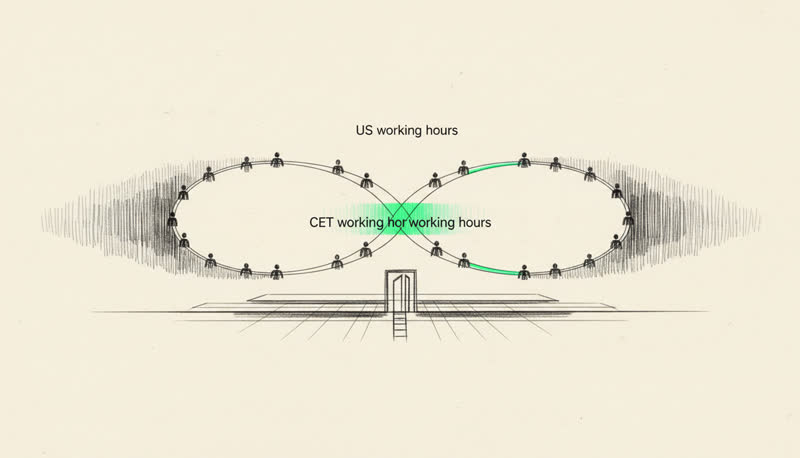
CET and the continental US barely share a working day, which breaks the assumption that a distributed team can just meet whenever. This piece maps the actual overlap hours and shows how to structure a team that spans both without forcing anyone into a permanent night shift.

A founder's first hire in a new country usually comes down to one decision: engage them as an independent contractor, or bring them on as a formal employee through an entity or an Employer of Record. This piece lays out the misclassification risk behind that choice using published penalty and case data.