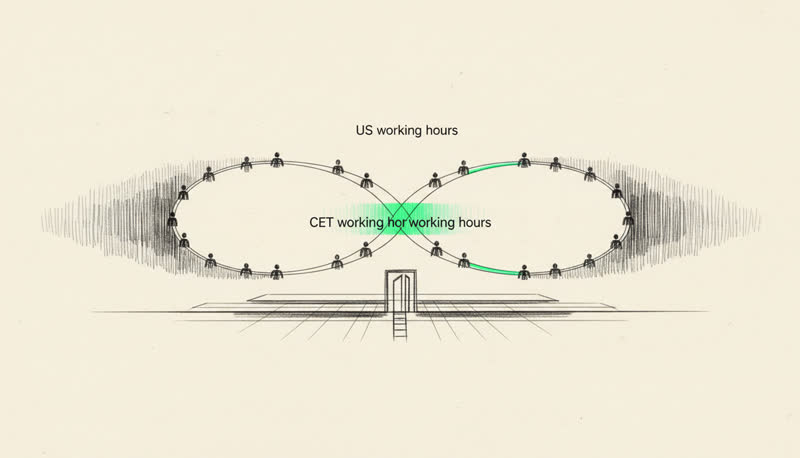
Nearshore hiring keeps a company inside a similar working day; offshore hiring trades time-zone overlap for a larger, lower-cost talent pool concentrated in a handful of countries. This piece lays out what published guides from Deel, Remote, and Oyster say each model actually requires.
Nearshore hiring places a role in a nearby country that shares most of a working day with your team, typically Latin America for a US company. Offshore hiring places that role in a distant country, most often South or Southeast Asia, trading time-zone overlap for lower cost and a larger talent pool concentrated in a handful of hubs.
Key numbers
Over 70 percent of offshore service providers concentrate their operations in a small number of countries, led by India, China, and the Philippines (Oyster).
Nearshore hires typically share most of the working day with a US team; offshore hires often have little to no overlap.
We search six regions for cross-border placements: Western Europe, North America, Balkans, Eastern Europe, Middle East, and Latin America.
Nearshore's cost gap versus onshore hiring can narrow over time in popular hubs (Deel); offshore's wider wage differential is the model's core premise (Remote).
What actually separates the two models
Deel's glossary on nearshoring describes it as prioritizing proximity and ease of communication over the lowest possible cost. A US company hiring in Latin America shares most of its working day with new hires there, so feedback loops run close to real time instead of across a 12-hour gap.
Remote's HR glossary defines offshoring as relocating work to a distant country primarily to cut costs on labor, infrastructure, and overhead, most often in South or Southeast Asia. The tradeoff is explicit: you accept slower communication and language differences in exchange for a wider cost gap.
Both are decisions about where the work gets done, not about the legal mechanism you use to pay for it. A nearshore hire and an offshore hire can both be structured as an employer-of-record arrangement or a direct contractor relationship; geography and time zone are the variables doing the work here, not the contract type. If you have not settled which of those legal structures fits your situation, see employer of record vs contractor before you lock in a country.
We treat this as part of calibrating a role before we search for it: which region makes sense depends on how the role actually needs to function day to day, not just on where the cheapest qualified person happens to live.
Time-zone overlap: the real-time tax or the round-the-clock gain
Nearshore hiring buys you overlap. A team in Mexico City, Bogota, or Sao Paulo is working roughly the same hours as a team in Austin or Chicago, which means a Slack question gets answered in minutes, a design review happens live, and a blocked engineer does not wait until the next morning for an answer.
Offshore hiring trades that overlap away. A team in Manila or Bangalore working against a US East Coast day has only a narrow window, if any, where both sides are awake and online. That gap can slow decisions that depend on back-and-forth: a product spec that needs three rounds of clarification, a client call that needs someone present live.
The same gap that slows synchronous work can be a gain for asynchronous work. An offshore team picking up tickets at the end of a US day and closing them out before the US team logs back on gets you something close to round-the-clock coverage, not a liability. Whether that pattern fits your team is a scheduling and workflow question more than a hiring question, and it is worth working through before you pick a region; remote hiring across time zones and building a distributed team across US and CET time zones both walk through how that plays out in practice.
Cost: a narrowing middle ground vs a wider gap
Nearshore hiring sits as a cost-effective middle ground relative to onshore hiring, but Deel's own guidance flags a real caveat: popular nearshore destinations can see cost creep, where the financial gap between the home office and the nearshore site narrows faster than companies expect as those hubs mature and demand for the same talent rises locally and internationally.
Offshore hiring chases a larger wage differential by design. The entire premise, per Remote's glossary, is relocating work specifically to cut costs on labor, infrastructure, and overhead, which only works if the gap between home-country and destination-country costs stays wide. That is part of why offshore sourcing clusters so heavily around a small number of established hubs instead of spreading evenly across low-cost countries: scale and specialization compound the cost advantage, and a thin, early-stage market does not offer either.
Neither model removes a decision you have to make yourself: at what point does the cost saving stop justifying the coordination overhead. Nobody publishes a universal answer to that, because it depends on the role, the stakes of slow feedback, and how mature the local market already is. When we run a search across these regions, that tradeoff is one of the first things we calibrate before sourcing starts, not something we solve after the fact. Pricing for a search runs on the same structure regardless of region, sourcing, full search, or embedded capacity, and is available on request once the role is scoped; see how those models differ on the Hiring Scorecard.
Talent pool: wide but concentrated
The offshore talent pool is large, but it is not evenly distributed. Oyster's glossary on offshoring treats offshoring and nearshoring as distinct operating-model decisions, separate from ordinary remote hiring, and cites research showing that over 70 percent of offshore service providers concentrate their operations in a small number of countries, with India, China, and the Philippines among the most common.
That concentration cuts two ways. It deepens the specialized talent available in those markets: decades of outsourced software development, support, and operations work in India and the Philippines mean deep benches of people who have done exactly the kind of work you are hiring for. But it also means the time-zone gap is structural, not incidental. The countries with the deepest offshore talent pools are also the ones furthest from US and Western European working hours.
Nearshore talent pools are smaller and more fragmented across countries, but the tradeoff runs the other way: a narrower bench in exchange for a working day that overlaps with yours. We search Eastern Europe and the Balkans as part of the same proximity logic for European clients, which is why country-level differences matter even within a region that counts as nearshore. A guide to hiring engineers across specific European and Eastern European markets illustrates how much that varies; see hiring engineers in Poland vs Kosovo vs Romania for how that comparison plays out at the country level.
When nearshore fits, when offshore fits
Nearshore tends to fit roles where someone needs to feel present during the working day: client-facing work, real-time collaboration with a product or engineering team, anything where a founder wants a team member in standups and able to jump on a call without a scheduling negotiation. A customer success lead, a founding engineer working in tight loops with a small team, a sales development rep who needs to be live when prospects are, are all roles where the overlap matters more than the savings.
Offshore tends to fit asynchronous, high-volume, or round-the-clock work where the time difference is a feature rather than a cost. Support coverage that needs to span a 24-hour cycle, high-volume data labeling or QA work that does not depend on live back-and-forth, back-office processing that runs on its own schedule, all benefit from offshore structures precisely because nobody needs to be awake at the same time.
Nearshore
Offshore
Time-zone overlap
Most of the working day shared
Little to no shared working day
Cost gap vs onshore
Cost-effective middle ground; can narrow in popular hubs (Deel)
Larger wage differential is the core premise (Remote)
Talent pool
Smaller, more fragmented across countries
Large but concentrated; over 70% of providers sit in a handful of countries (Oyster)
Most companies end up running both models at once rather than choosing one: a nearshore hire for the founding engineer who needs to be in standups, an offshore team for support coverage that runs overnight. The decision is per role, not per company, and it is the same question we ask in a calibration call before we open a search in any of the six regions we work across.
The short version
Nearshore buys you time-zone overlap at a cost gap that is real but can narrow in popular hubs; offshore buys you a wider cost gap and a deeper, if more distant, talent pool concentrated in a handful of countries. Pick nearshore for roles that need real-time presence, offshore for roles that run asynchronously or benefit from round-the-clock coverage, and expect most companies to use both at once, split by role rather than by company-wide policy.
FAQ
Is nearshore always cheaper than onshore but more expensive than offshore?
Generally yes, nearshore sits as a cost-effective middle ground relative to onshore hiring, but Deel's guidance notes that the gap between home-office and nearshore costs can narrow over time in popular destinations as those hubs mature. Offshore hiring, per Remote's glossary, is built specifically around chasing a wider wage differential, which is why it typically remains the lower-cost option of the two, but the exact gap depends on the role, the country, and how established that country's outsourcing market already is.
Why is offshore talent so concentrated in a few countries instead of spread out?
Oyster's glossary cites research showing over 70 percent of offshore service providers concentrate their operations in a small number of countries, led by India, China, and the Philippines. Decades of established outsourcing infrastructure, specialized talent benches, and language proficiency in those markets compound over time, which makes it harder for newer, lower-cost markets to compete on the same scale even when their wages are comparable.
Can the same company use both nearshore and offshore hiring at once?
Yes, and it is common for growth-stage companies to split roles by how much real-time interaction each one needs rather than picking a single region for everything. A broader look at how cross-border search works across both approaches, including where a recruiting partner adds value versus where a company can run the hire internally, is in the international recruitment agency guide.
A criteria-first look at international recruitment agencies startups actually consider, including Recruitmint, with the stated basis for inclusion and a link to each firm's own site.
CET and the continental US barely share a working day, which breaks the assumption that a distributed team can just meet whenever. This piece maps the actual overlap hours and shows how to structure a team that spans both without forcing anyone into a permanent night shift.
A founder's first hire in a new country usually comes down to one decision: engage them as an independent contractor, or bring them on as a formal employee through an entity or an Employer of Record. This piece lays out the misclassification risk behind that choice using published penalty and case data.
 Recruit