 Recruit
How to Hire in LATAM: A Guide for US and European Companies
What to check before you hire in Mexico, Brazil, Colombia and Argentina: talent pools, time zones, contractor rules and the compliance questions that come up first.
What to check before you hire in Mexico, Brazil, Colombia and Argentina: talent pools, time zones, contractor rules and the compliance questions that come up first.

How to hire in LATAM depends on which country you mean. Mexico, Brazil, Colombia and Argentina differ in labor rules, contractor classification, time zone overlap and talent depth by function, so a single regional approach rarely works. Recruitmint lists Latin America as one of six regions it searches, calibrating each search to a market's realities rather than running one process region-wide.
Key numbers
A founder who says "we want to hire in LATAM" is usually solving one of three problems: finding engineering or product talent at a lower cost base than the US, building overlap with US business hours for a customer-facing or revenue role, or opening a delivery hub in a market where the company already has customers. Mexico, Brazil, Colombia and Argentina each answer a different version of that problem, and the differences that matter most to a hiring decision are the ones that vary most: labor classification rules, typical compensation bands, language requirements, time zone alignment, and how deep the talent pool runs for a specific function and seniority.
None of those variables are the same across the four countries, which is exactly why a single hiring process applied uniformly across the region tends to underperform. The team's collective background spans international executive search, full-cycle recruitment and workforce planning across the US, Canada, EMEA, LATAM and South Africa, and that background shapes a stated calibration philosophy: hiring standards, candidate markets, compensation expectations and operating environments vary significantly by region, so we calibrate a search to the realities of each market rather than applying the same approach everywhere. That calibration step, not the sourcing step, is usually where a LATAM hire succeeds or fails.
A reader comparing Mexico, Brazil, Colombia and Argentina is looking for specifics: how many qualified backend engineers exist in each market, what the going rate is for a Head of Growth in Mexico City versus Sao Paulo, how many hours of overlap a Bogota-based team has with New York, and whether a given country treats a long-term contractor as a de facto employee after a certain tenure. Those are exactly the questions worth answering before a search starts, and none of them have a single, stable answer that holds for more than a year or two.
We do not state talent pool sizes, time zone tables, contractor classification thresholds or compliance rules for any of the four countries in this guide, because no verified, dated source for those figures was available when it was written. Labor law changes by statute and by court ruling, salary bands move with currency swings and inflation, and "talent pool size" depends entirely on how narrowly a function and seniority are defined. A number without a source and a date is not a fact, it is a guess with a decimal point, and a hiring plan built on it is a hiring plan built on sand.
The practical instruction is simple: before opening a role in Mexico, Brazil, Colombia or Argentina, get the current contractor-classification rule, the current time zone offset relative to your team, and a current salary range from a source you can cite and date, not from a blog post (including this one) that does not cite one. Local employment counsel, a licensed Employer of Record provider, or a government labor ministry publication are the right places to get numbers that will actually hold up.
The categories below are the ones that come up first in almost every LATAM search, regardless of country. The right answer to each varies by market and by date, so the table names the question and where to verify it, not the answer itself.
| Area to check | Why it matters | Where to verify it |
|---|---|---|
| Contractor vs. employee classification | Misclassifying a long-term contractor can create back-pay, tax and penalty exposure in several LATAM jurisdictions | Local employment counsel or a licensed Employer of Record provider in that country |
| Time zone overlap | Determines how much live collaboration is realistic for a given function (support, sales, engineering pairing) | A current time zone reference checked against your team's working hours, not an assumed UTC offset |
| Compensation band for the role and level | Comp expectations differ by country, city and currency, and shift with inflation and exchange rates | A current, dated salary data source specific to the country and function, not a regional average |
| Statutory benefits and termination rules | Several LATAM countries require benefits (bonuses, severance formulas, notice periods) well beyond US norms | Local counsel or an EOR provider's current country guide |
| Language and client-facing requirements | Some roles need Spanish or Portuguese fluency; others need English-first because of the reporting line | Defined in the role brief before sourcing starts, not inferred from the country |
Several readers in this situation are deciding between hiring a contractor directly, using an Employer of Record, or opening a local entity. That decision is covered in more depth in contractor versus employee for a first international hire and in Employer of Record versus contractor, both of which walk through the structural tradeoffs without assigning a single answer to every country.
Almost every LATAM hiring conversation reaches this question within the first few minutes: can we just hire this person as a contractor. The honest answer is that it depends on the country, the role, and how the relationship actually functions day to day, not on what the offer letter calls it. A contractor who works set hours, uses company equipment, reports to a manager like an employee, and has no other clients starts to look like an employee under several LATAM labor frameworks regardless of the label on the contract.
This is not a rule we can state precisely for Mexico, Brazil, Colombia or Argentina individually, because the thresholds and tests differ by jurisdiction and change over time. It is a rule worth getting from current local counsel or an EOR provider before the first offer goes out, not after the role has been filled for a year. The cost of getting this wrong is rarely the search itself; it is the exposure that accumulates quietly while the hire is performing well.
We describe our Latin America work specifically as international RPO and specialist search: sourcing, screening, shortlist development, client delivery. That is a structural description, not a promise about volume or speed, and it maps onto the three engagement models available for any search, including one run across Mexico, Brazil, Colombia or Argentina.
The diagram below shows how calibration sits between defining the role and running the search, and why that step gets checked separately for each country even when the function and seniority are identical.
Once the role and market are calibrated, the structural choice is the same one that applies to any search: how much of the process to hand off, and for how long. These are the three models, described by what is included, not by price.
| Model | What is included | Fee structure | Pricing |
|---|---|---|---|
| Sourcing Sprint | You run interviews internally; we identify, engage and qualify candidates and hand over a calibrated shortlist | Structure only; no success fee is described for this model | On request |
| Full Search | End-to-end work from calibration through assessment, interviews, offer and close | A launch fee plus a success fee on placement | On request |
| Embedded Partner | Dedicated recruitment capacity for multiple active roles, working as an extension of your team | A monthly fee plus a reduced success fee | On request |
Fees vary based on role seniority, search complexity and hiring volume, and executive-level, highly specialized or unusually complex searches are quoted individually; none of the three models publishes a fee figure here or anywhere else on the site. If you are deciding between these three structures, in LATAM or any other region, Sourcing Sprint versus Full Search and what an Embedded Partner model looks like compared to an in-house recruiter walk through the longer version of that comparison. The Hiring Scorecard is a faster path: it asks nine questions, scores Role Clarity, Hiring Readiness, Talent Market Fit and Recruitment Capacity, and recommends a model based on how many roles are open and what kind of support is needed, rather than on region alone.
A single, well-defined mid-level role with a clear job description, a working pipeline of inbound applicants, and a hiring manager who already knows the market does not need a search partner. Post the role, run the interviews, and use the time saved to calibrate the next hire.
The calculus changes when any of the following are true: the role is senior or hard to define precisely, the company has no existing network in the target country, the search needs to run across more than one LATAM market at once, or the hire has to clear a compliance bar (contractor classification, data residency, client security requirements) that your team has not navigated before. That is also where a region-spanning view helps, since the strongest candidate for a role is not always sitting in the country a founder first thought of; we search Western Europe, North America, the Balkans, Eastern Europe, the Middle East and Latin America for exactly that reason. A broader look at how an international recruitment agency actually runs a cross-border search, or how nearshore hiring compares to offshore hiring, is useful background before committing to a region.
| Criterion | What "ready" looks like | Evidence to gather |
|---|---|---|
| Role definition | The function, seniority and success criteria are written down, not just a title | A one-page role brief, not a job board template |
| Contractor vs. employee decision | A specific classification plan exists for the target country, not an assumption | A written opinion from local counsel or an EOR provider, dated |
| Compensation band | A current, country-specific range has been set, not a regional guess | A dated salary source specific to the function and country |
| Time zone plan | The required overlap hours are defined against your team's actual schedule | A documented working-hours comparison, checked against current time zone data |
| Language requirement | Spanish, Portuguese or English-first is specified for the role before sourcing starts | Included in the role brief |
| Search approach | A decision has been made on sourcing internally, running a single search, or opening ongoing capacity | A completed Hiring Scorecard or an equivalent internal assessment |
Hiring in LATAM is four separate hiring decisions, not one regional strategy, and the biggest mistake is treating Mexico, Brazil, Colombia and Argentina as interchangeable because they sit on the same continent. Get current, dated, country-specific answers on contractor classification, compensation and time zone overlap before writing the role brief, not after. We search Latin America alongside five other regions and calibrate each search to the market rather than applying one process everywhere, through the same three structures (Sourcing Sprint, Full Search, Embedded Partner) used for any region, with pricing available on request.
Compensation levels vary by country, city, currency and role, and we do not state a specific range for Mexico, Brazil, Colombia or Argentina here because no verified, dated source for those figures was supplied. Get a current, country-specific salary benchmark from a dated source before building a budget around an assumed discount.
It depends on the country, the role, and how the working relationship actually functions, not on the label in the contract. Several LATAM jurisdictions test classification based on hours, equipment, exclusivity and supervision, so this is a question for local employment counsel or an Employer of Record provider before the first offer goes out, covered in more depth in contractor versus employee for a first international hire.
No. Our published testimonials are not LATAM placements and should not be read as proof of LATAM outcomes. What we do publish is that Latin America is one of the six regions we search, and that we describe our LATAM work as international RPO and specialist search: sourcing, screening, shortlist development, client delivery, detailed on the about section.
If the need is sourcing only for a single role, a Sourcing Sprint usually fits; if there is ongoing support needed or four or more roles open, Embedded Partner is the structure built for that; most single, high-impact or hard-to-fill roles fall into Full Search. The Hiring Scorecard applies exactly that logic in about two to three minutes.
At minimum: the current contractor-classification test in that country, a dated compensation benchmark for the specific role and level, the real time zone overlap with your existing team, and any statutory benefits or termination rules that apply. None of these should come from a general LATAM guide; they need a country-specific, dated source.

A criteria-first look at international recruitment agencies startups actually consider, including Recruitmint, with the stated basis for inclusion and a link to each firm's own site.
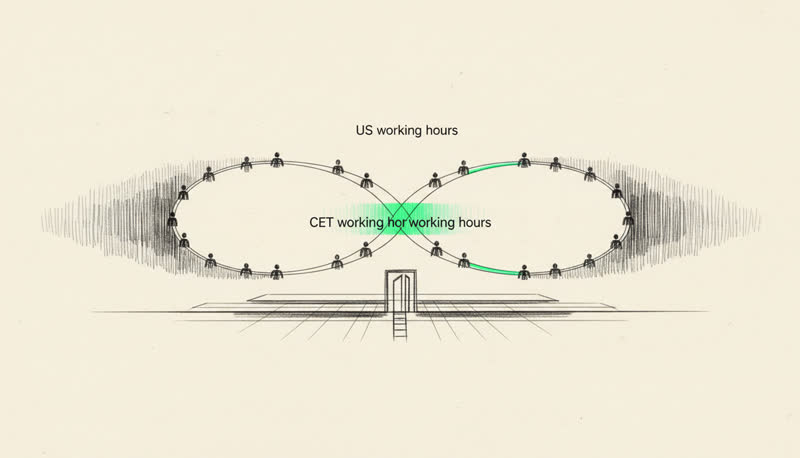
CET and the continental US barely share a working day, which breaks the assumption that a distributed team can just meet whenever. This piece maps the actual overlap hours and shows how to structure a team that spans both without forcing anyone into a permanent night shift.

A founder's first hire in a new country usually comes down to one decision: engage them as an independent contractor, or bring them on as a formal employee through an entity or an Employer of Record. This piece lays out the misclassification risk behind that choice using published penalty and case data.